
In the digital-first business world of 2025, customer relationships have become the cornerstone of business success. In fact, it’s often said that a company’s reputation is built on the strength of its relationships with its customers. But what happens when you have different types of customers with distinct needs and behaviors? This is where Customer Relationship Management (CRM) software comes into play. Choosing the right CRM system for your business—whether it’s B2B (Business-to-Business) or B2C (Business-to-Consumer)—can significantly influence your ability to scale, grow, and meet your customers’ expectations.
When evaluating CRM systems, one of the biggest questions often arises: Do you need a B2B CRM or a B2C CRM? While both share a common goal of improving customer relationships and driving revenue, the way they operate, their use cases, and the technology behind them are very different. Let’s dive deep into the key distinctions between B2B and B2C CRM, and help you choose which one fits your business best in 2025.
A B2B CRM (Business-to-Business Customer Relationship Management) is specifically designed for businesses that engage with other businesses. B2B businesses often deal with high-value transactions, long sales cycles, and multiple stakeholders within a client organization. B2B CRMs are essential for managing these complex relationships and ensuring all parties are aligned. They are ideal for organizations that sell high-ticket products or services, deal with long-term contracts, and need to track the progress of multiple deals simultaneously.
Key Features of B2B CRMs:
A B2C CRM (Business-to-Consumer Customer Relationship Management) is tailored for businesses that sell directly to individual consumers. B2C businesses typically deal with a high volume of transactions, fast-paced sales, and a need for effective consumer-focused marketing strategies. These CRMs are designed to manage large volumes of leads and customers, offering automation and scalability to efficiently handle transactions in consumer-facing industries.
Key Features of B2C CRMs:
Feature | B2B CRM | B2C CRM |
Target Audience | Businesses (Long-term contracts, multiple decision-makers) | Consumers (High volume, fast-paced sales) |
Sales Cycle | Long and consultative | Short and transactional |
Data Points | Company info, multiple contacts, deal stages | Individual behavior, preferences, and purchase history |
Marketing Strategy | Account-based, personalized outreach | Mass campaigns, behavioral triggers |
Lead Nurturing | Human-driven, tailored | Automated and scalable |
Example CRM Tools | Salesforce, HubSpot, Zoho CRM | ActiveCampaign, Klaviyo, Mailchimp CRM |
The differences are clear, but both types of CRM systems ultimately focus on strengthening relationships with customers. However, the way each system operates and the tools it offers vary significantly based on the target audience and business objectives.
As we approach 2025, CRM systems are becoming indispensable tools for businesses worldwide. Here are some essential statistics to consider:
These statistics highlight the growing reliance on CRM systems for managing customer relationships and driving business success.
“One customer well taken care of could be more valuable than $10,000 worth of advertising.” – Jim Rohn
This quote perfectly captures the essence of CRM. A well-maintained customer relationship can yield higher returns than any marketing campaign. It emphasizes the importance of providing personalized and attentive customer service, which is precisely what B2B and B2C CRMs help businesses achieve.
CRM spending continues to grow as businesses realize the value of maintaining strong relationships with customers. Here are some key statistics on CRM expenditure:
This shows that CRM is not just a tool for small businesses—it’s becoming a necessity for large enterprises, where maintaining strong customer relationships is key to long-term success.
The CRM software market is on a rapid growth trajectory, driven by increasing demand for customer management solutions:
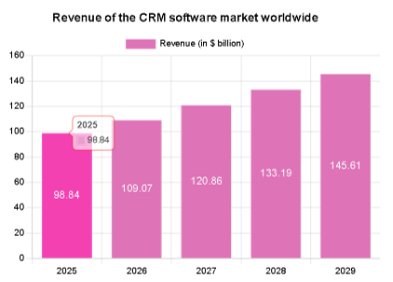
These figures highlight the exponential growth of the CRM industry and its significant role in the future of customer relationship management.
In 2025, CRM systems are not just about storage and contact management; they are sophisticated, intelligent tools that provide valuable insights into customer behavior. This difference between B2B and B2C CRM systems becomes even more pronounced with the rise of AI-powered CRMs.
AI-driven CRMs are revolutionizing how businesses engage with customers, making it crucial for organizations to choose the CRM that best fits their needs.
 B2B Use Case:
A SaaS company selling HR software uses Salesforce to manage multiple stakeholders within client organizations. The CRM helps automate proposal workflows, tracks negotiation stages, and ensures that each part of the sales cycle is optimized. This enables the company to maintain strong, long-term relationships with their B2B clients.
B2C Use Case:An online skincare brand uses Klaviyo to send automated follow-ups after a purchase, recover abandoned carts, and segment customers based on skin type and concerns. This allows them to provide personalized experiences at scale, keeping their customers engaged and encouraging repeat purchases.
When deciding between a B2B or B2C CRM, ask yourself the following questions:
Answering these questions will guide you to the right CRM solution for your business.
Yes! Many businesses, especially those with hybrid models, serve both B2B and B2C segments. The good news is that many CRM platforms like HubSpot, Zoho, and Freshsales offer customizable modules that can handle both workflows. However, clarity is essential. Customize your CRM experience based on your primary revenue stream to avoid data clutter and inefficiencies.
One of the biggest trends in CRM technology for 2025 is AI-powered CRMs. Modern CRMs are becoming smarter, predictive, and more helpful. With AI integration, your CRM can:
These features are transforming the way businesses engage with customers, providing sales, marketing, and support teams with a competitive edge.
AI & Automation: Both B2B and B2C CRMs are leveraging AI for personalization, lead scoring, forecasting, and campaign efficiency. The key difference lies in how these technologies are applied—B2B focuses on pipeline intelligence, while B2C relies on real-time personalization.
Omnichannel & Integration: Both models require seamless interactions across multiple channels, including email, social media, and live chat. The demand for integrated systems is increasing as businesses aim to provide cohesive customer experiences.
In 2025, the best CRM system for your business is the one that fits your specific needs. It’s not about the most expensive or feature-packed system, but the one that helps you build stronger customer relationships and scale effectively.
Whether you’re handling enterprise-level deals or engaging with thousands of consumers, CRM is the tool that can drive growth. Choose wisely, customize endlessly, and automate where it counts.
The future of CRM is about merging B2B and B2C strategies—leveraging the best technologies to provide exceptional, personalized experiences for all types of customers.
Category: Business
Tags: CRM, Customer Service